NCYSUR NHMRC Research Fellow Dr Carmen Lim welcomed harm reduction delegates from Japan in November
NCYSUR Project update- Bilateral Australia–Japan Drug Policy Initiative
December 2025
Teaser image
As previously reported in the March and September editions of Connections, this bilateral initiative between Australia and Japan funded by the UQ 2025 Global Partnerships Scheme is developing a multi-national survey examining drug use and harm-minimisation practices.
The collaboration led by NCYSUR NHMRC Emerging Leadership Fellow Dr Carmen Lim, Dr Cheneal Puljevic and PhD student Mr Jack Chung brings together researchers, advocates, and persons with lived experience across both countries to address a longstanding evidence gap: neither Australia nor Japan has previously implemented a comprehensive, cross-culturally comparable survey focusing specifically on harm reduction behaviours, service engagement, and public awareness of drug-related risks.
With Australia operating within a mature harm-reduction system and Japan maintaining a zero-tolerance, abstinence-focused policy environment, this project provides a unique opportunity to strengthen research capacity, share expertise, and lay the groundwork for an internationally aligned survey instrument.
The Global Partnerships Project runs from August 2025 to July 2026 and prioritises reciprocal knowledge exchange. Japanese researchers, students and advocates travelled to Australia in November, where they attended APSAD in Sydney and engaged with practitioners and people with lived experience.
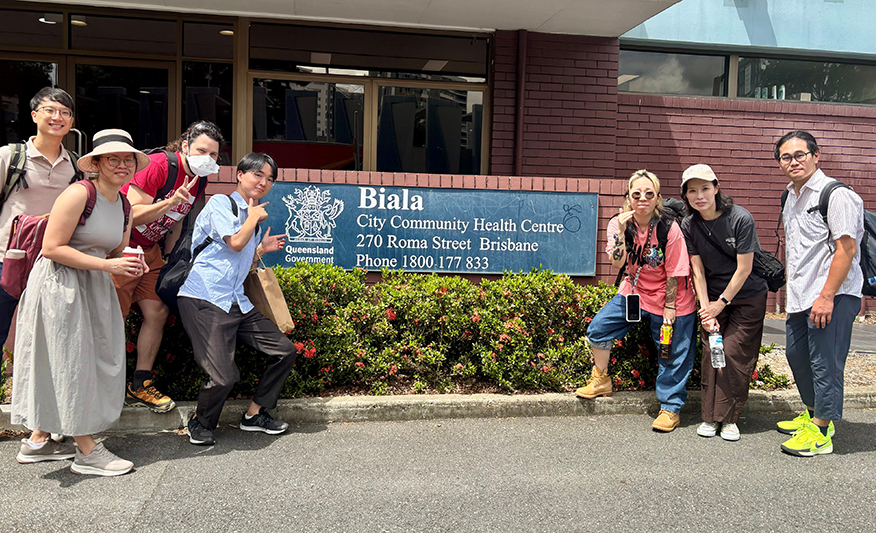
In Brisbane, the Japanese delegation including Dr Ayumi Takano, Yuto Suzuki, Dr Munemori Katayama, and Harm Reduction advocate Chris, along with research staff and NCYSUR PhD students Mr Jack Chung, Ms Caitlin McClure-Thomas, Ms Jiaxin Li, and Ms Yan Yee Lee began their Brisbane tour with a briefing from Professor Jason Ferris and Dr Cheneal Puljevic at UQ to learn about the challenging logistics of the Global Drug Survey.
Over the next several days the delegation visited major harm-reduction sites, first meeting with Cameron Francis, CEO of The Loop Australia drug checking services, currently prevented from operating in Queensland. At Herston, the visitors were briefed by Nik Alexander, Senior Program Manager of Harm Reduction at QuIHN, provider of free and confidential services to those affected by substance use and related health issues.
At the Biala City Community Health Centre, the group met with Dr Jason Lana and Nurse Practitioner Julie Luff. The site visit continued with Jeff Buckley and the team at Insight, the Queensland Health AoD workforce development group.
The following day was spent at NCYSUR house at UQ St Lucia Campus for a discussion with Director Professor Jason Connor, drawing upon his knowledge of policy-relevant research as well as his role as a clinician in the public hospital service focusing on alcohol use disorders.
The Japanese team spoke to NCYSUR researchers and students about the very different policy landscape in Japan where NSP, drug checking, naloxone, and drug education are unknown, legal substances such as alcohol and OTC medications are readily available, and illicit drug use is harshly punished.
Dr Tim Piatkowski also addressed the group on steroid harm reduction and the need for pragmatic, stigma-free strategies to curb growing harms from performance and image-enhancing drug use.
The site visits concluded the following day with a visit to a Narcotics Anonymous meeting and the Brisbane Photovoice exhibition "Seen and Heard", sponsored by QUIVAA.
These experiences enabled the Japanese team to gain firsthand insights into harm-reduction models, operational protocols, and implementation challenges within an established system. An Australian delegation will travel to Japan in 2026.