NCYSUR’s NHMRC Emerging Leadership Fellow Dr Carmen Lim reports on a harm reduction symposium in Tokyo with the National Centre of Neurology and Psychiatry
Harm reduction – insights from Australian policy and research for Japan’s public health future
March 2025
Teaser image
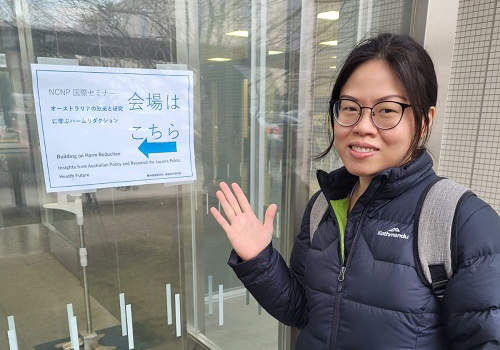
In 2024, NHMRC Emerging Leadership Fellow Dr Carmen Lim received a grant from the National Centre of Neurology and Psychiatry (NCNP) and the Ministry of Health, Labour and Welfare to co-organise a national hybrid symposium on harm reduction in Japan alongside NCNP colleagues.
This symposium showcased the work of UQ academics Dr Carmen Lim, Emeritus Professor Wayne Hall, Associate Professor Phong Thai, Dr Cheneal Puljevic, and Associate Professor Caroline Salom on addiction research topics. NCYSUR academics Carmen and Wayne presented on youth vaping in Australia and the impact of cannabis legalisation in the US and Canada. Held on January 21, 2025, the event attracted over 60 online participants, and 30+ in-person attendees, including individuals with lived experience, physicians, graduate students, mental health professionals, and social workers from across Japan.
The Q&A and discussion sessions provided valuable insights into the Japanese perspective on harm reduction, particularly from people with lived experience. These conversations highlighted cultural and legal differences that shape harm reduction approaches in Japan and why Australia’s current model may not be directly applicable. Participants discussed Japan’s strict drug laws, particularly around marijuana, and the challenges of implementing evidence-based harm reduction strategies within this framework. The interactive discussions allowed for a deeper understanding of the barriers to policy reform.
The following day, Carmen and Cheneal visited the University of Tokyo (Tōdai), Japan’s most prestigious university, globally recognised for its excellence in academic research and innovation.
They met with academics from the Department of Mental Health Faculty and presented their work to 12+ graduate students and staff. Carmen spoke about her recently published work on medicinal cannabis and Cheneal spoke about mental health studies based on the Global Drug Survey.
Carmen and Cheneal were also given the opportunity to observe the SMARPP (Serigaya Methamphetamine Relapse Prevention Program). The program accommodates individuals of diverse ages and genders, providing structured support for relapse prevention. This program also serves as a court-mandated intervention for some participants seeking to avoid incarceration.
Additionally, they were given a lab tour where they observed preclinical research on novel psychoactive substances and opioid withdrawal, where animal models such as rats and fish were used to study the neurobiological mechanisms of addiction and withdrawal.
On the final day, Carmen and Cheneal visited the Institute of Science, Tokyo, where they co-presented in a faculty seminar with staff from the Graduate School of Medical and Dental Sciences. Their Japanese counterparts exchanged research and discussed internet addiction, while Carmen and NCYSUR PhD candidate Mr Jack Chung presented on cannabis use in the USA, Canada and Australia.
This trip has fostered a rich exchange of perspectives, highlighting differences in policy, public health approaches, and emerging research trends between Japan and Australia. It also prompted reflections on how accessibility, regulation, and cultural attitudes shape substance use behaviours. For instance, while cigarettes remain widely available and relatively cheap in Japan, the daily smoking rate is only slightly higher than in Australia. These observations have sparked future research ideas, particularly on how, policy and shifts in social norms influence, and the availability of alternative products influence substance use trends.