Recommendations for reporting the use of alcohol, tobacco, and other drug screening tools among specific Aboriginal and Torres Strait Islander populations
Reporting ATOD screening tool use with pregnant Aboriginal and Torres Strait Islander Peoples
December 2025
Teaser image
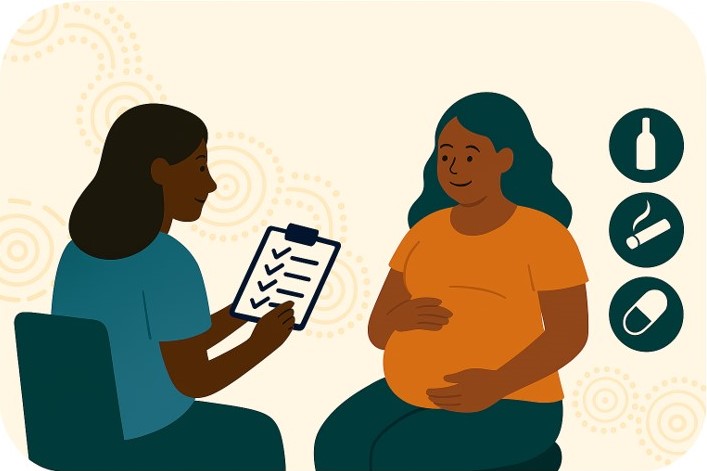
Norris C.A, Johnson T, Bartram A, Muminovic A, McEntee A, Fischer J, Francis A & Bowden J. Recommendations for reporting the use of alcohol, tobacco, and other drug screening tools among specific Aboriginal and Torres Strait Islander populations. Health Promotion Journal of Australia, 36(4), e70103. September 2025. https://doi.org/10.1002/hpja.70103
Alcohol, tobacco and other drug screening tools are routinely used in antenatal care to identify risks and support healthier pregnancies. However, there is limited evidence on whether these tools are culturally responsive, validated, and acceptable for use with pregnant Aboriginal and Torres Strait Islander peoples. This commentary addresses that gap and provides recommendations for improving reporting practices.
Commonly used tools such as AUDIT, AUDIT-C, and ASSIST are not validated for use with pregnant Aboriginal and Torres Strait Islander women. None of the reviewed studies reported on cultural responsiveness or acceptability of these tools. This lack of evidence highlights the need for co-designed, culturally safe screening practices. Successful models like the Kimberley Mum’s Mood Scale show that culturally grounded tool development is feasible.
Future research should report on cultural responsiveness, acceptability, and validation of Alcohol, tobacco and other drug screening tools when used with pregnant Aboriginal and Torres Strait Islander peoples to strengthen the evidence base and guide best practice.
Embedding cultural responsiveness in screening aligns with principles of equity and empowerment outlined in the Ottawa Charter. It can improve antenatal engagement, reduce stigma, and contribute to better maternal and child health outcomes.
This research was supported by Drug and Alcohol Services South Australia.
Read the full article here.