The South Australian MAP created a culturally safe, holistic environment that reduced risky alcohol use and improved access and connection to service.
Evaluation of a Residential Managed Alcohol Program for Aboriginal Peoples Experiencing Homelessness and Alcohol Dependence: Short-Term Impacts of an Australian Trial
September 2025
Teaser image
Thompson, K., Di Censo, G., Bowden, J., Georgiou, N., Thompson, M., Cock, V., Brewerton, B., & Ryder, C. (2025). Evaluation of a Residential Managed Alcohol Program for Aboriginal Peoples Experiencing Homelessness and Alcohol Dependence: Short‐Term Impacts of an Australian Trial. Drug and Alcohol Review. https://doi.org/10.1111/dar.70025
Learn more about how the program was run in this recording of a presentation by Drug and Alcohol Services South Australia staff at NCETA’s 2025 Symposium here.
Background
Managed Alcohol Programs (MAPs) are harm reduction interventions that provide regulated alcohol doses in supervised settings, aiming to stabilize consumption and connect individuals with health and social services without requiring abstinence. NCETA was engaged by Drug and Alcohol Services South Australia (DASSA) to evaluate the short-term impacts of South Australia's first MAP conducted in a healthcare setting and designed to meet the needs of Aboriginal peoples experiencing homelessness and alcohol dependence. The program operated for 12 weeks in 2023 and was the first of its kind in South Australia (SA) outside COVID-19 emergency responses in Australia.
Methods
The evaluation used a mixed-methods retrospective analysis of de-identified case notes from 21 clients who stayed at least one night. It was overseen by an Aboriginal Governance Group. Most participants were Aboriginal women of middle age, managing multiple health conditions. The median stay was 15 nights, with some clients re-entering up to two times. Drinking patterns prior to entry were marked by chaotic cycles of heavy use, withdrawal, and emergency service involvement. Although abstinence was not a goal, six clients ceased drinking—four through withdrawal and two via gradual reduction.
Findings
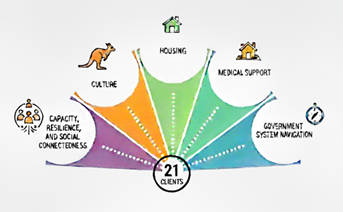
Short-term benefits were categorized into five interconnected domains:
- Culture: Cultural safety was prioritized through Indigenous staff, language support, and activities like art, cooking kangaroo tail (marlu wipu), and connection to Country. Clients engaged with Aboriginal-led health services and some participated in Sorry Business.
- Medical Support: Clients accessed a range of health investigations and received new or renewed prescriptions. Eleven clients were referred to healthcare providers, and six received new diagnoses.
- Housing: The program provided 399 nights of accommodation. Twelve clients returned to family, and three secured housing during the MAP.
- Government System Navigation: Clients were supported in navigating nine government systems, including income support, legal aid, and aged care. Outcomes included securing concession cards, attending child access visits, and have fines reduced.
- Capacity, Resilience, and Social Connectedness: Clients received education on harm reduction, were connected to employment and education services, and supported in daily living activities.
Discussion
The SA MAP created a culturally safe, holistic environment that reduced risky alcohol use and improved access and connection to - and trust in - services. It addressed common barriers such as transport, contactability, and distrust of formal institutions. While MAPs cannot resolve systemic determinants of ill health or overcome the impacts of systemic discrimination following colonisation, this trial demonstrated their feasibility and acceptability for Aboriginal peoples in urban healthcare settings.
Limitations include the short-term nature of the evaluation and lack of data linkage to assess long-term outcomes. Future programs could expand to other vulnerable populations, including those transitioning from care, experiencing domestic violence, or aging.
Conclusion
The South Australian MAP provided meaningful short-term benefits and supports international evidence for MAPs as effective harm reduction strategies. It highlights the importance of culturally tailored interventions for Aboriginal peoples facing homelessness and substance dependence.
Next steps
An economic evaluation led by Prof. Jon Karnon is currently underway to determine the cost-benefit of the SA MAP.