
Alcohol use is a major contributor to global disability, disease and mortality and is associated with significant social and economic costs [1, 2]. Use among young people is particularly concerning, and has been associated with a range of negative consequences including comorbid mental health problems [3], poor academic performance and adverse school outcomes [4]. Of considerable concern is the large body of evidence that associate early initiation to drinking with an increased risk of developing an alcohol use disorder [5, 6]. Given that for each year we delay the onset of drinking we reduce the odds of developing alcohol dependence by 9%, effective and early prevention is critical [7, 8].
An array of evidence-based programs to prevent alcohol use and related harms among adolescents have been developed and evaluated. Universal prevention programs are delivered to an entire population within a specific setting (e.g. school, university, family or community), regardless of level of risk [9]. Systematic reviews have shown that universal prevention programs can produce small to moderate effects in reducing alcohol use among adolescents [10, 11]. Selective prevention programs are targeted to subsets of a population who are identified as being at an increased risk of developing problems with alcohol. Selective interventions typically yield larger effects, however such programs have often been overlooked due to practical limitations and the possibility of stigmatisation [12]. A critical component of selective prevention programs is the identification of individuals at increased risk of developing alcohol-related problems. One area of risk that has shown to be particularly predictive of alcohol and other drug misuse is personality [13-20], with four specific personality profiles identified in this respect:
- Negative Thinking (NT): low mood, negative beliefs about self, others and future
- Anxiety Sensitivity (AS): fear of anxiety-related physical sensations
- Impulsivity (IMP): rapid decision-making and action, poor response inhibition
- Sensation Seeking (SS): elevated need for stimulation, risk-taking.
Each of these profiles is associated with specific patterns of alcohol misuse, motivations for use, and vulnerabilities to comorbid psychopathology [13, 21-24] as outlined in Figure 1.
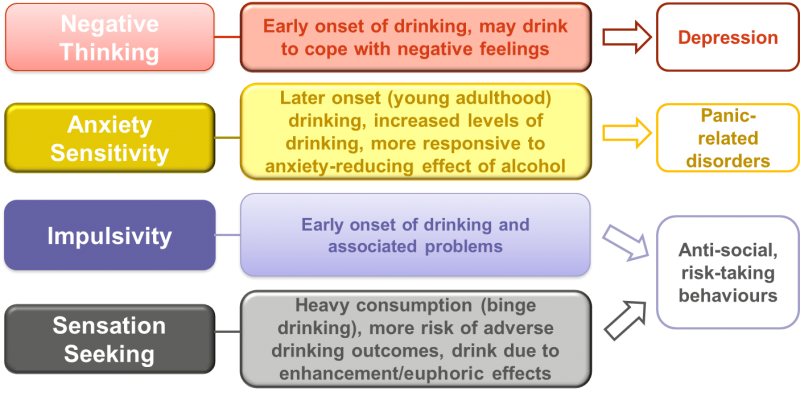
Figure 1. Personality profiles and alcohol use
Based on this research, the Substance Use Risk Profile Scale (SURPS) was developed to assess variability on the four personality profiles [13].The 23-item self-report questionnaire has been well-validated across a number of countries, with studies demonstrating good test-retest reliability, internal consistency, and concurrent and predictive validity among adolescents and young adults [13, 21, 25-27]. Importantly, our recently study showed the SURPS to be a valid and useful measure for identifying Australian adolescents at high-risk for substance use and other emotional and behavioural problems [28]. The SURPS focuses on assessing personality, rather than substance use, therefore enabling the identification of adolescents at risk for substance use and related problems prior to the onset of use. This unique feature of the SURPS is of particular relevance to selective prevention programs, such as the personality-targeted Preventure program [29-33].
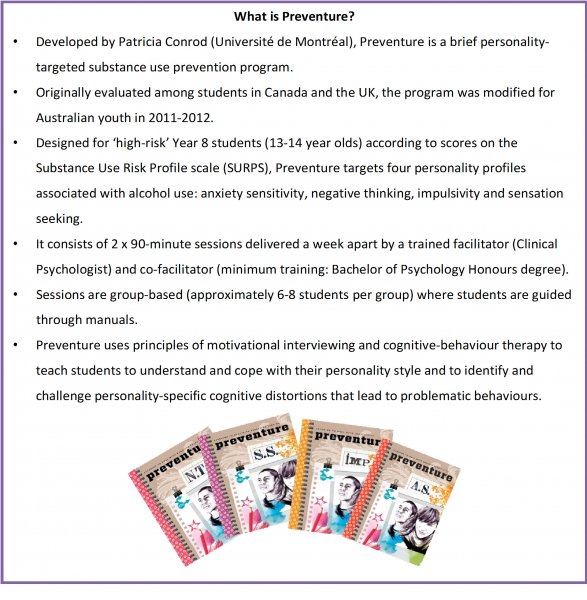
Results from randomised controlled trials (RCTs) of Preventure among adolescents in Canada and the United Kingdom have shown the program to be effective in preventing and reducing drinking rates and problematic drinking up to two years following the interventions [29-33]. However no trial has demonstrated the long-term effects of Preventure, and there has been no evaluation of a selective prevention program in Australia.
What were the aims of this study?
This study investigated the long-term effectiveness of Preventure in reducing the uptake of alcohol, harmful use of alcohol and alcohol-related harms among Australian adolescents [34]. We hypothesised that the Preventure intervention, targeting youth with one of four high-risk personality dimensions of anxiety sensitivity, negative thinking, impulsivity and sensation seeking, would be more effective than health education as usual in reducing the growth and severity of alcohol misuse and related harms. This study examined the effectiveness of Preventure over a three year period, the longest follow-up assessment ever conducted internationally of a personality-targeted intervention, and the first trial of a selective prevention program in Australia.
What did we do?
Study Design
The sample was derived from a four-arm cluster RCT designed to investigate the relative effectiveness of combined universal and personality-targeted school-based interventions to prevent substance use and harms (The CAP Study) [35]. This study focuses on high-risk students in two arms of the trial (the Preventure and Control groups). A cluster RCT was conducted in 14 secondary schools in Sydney and Melbourne between 2012 and 2015. Schools were block randomised to one of two groups: the Preventure group (n= 7) or a control group (n=7). All students were assessed on frequency of drinking, binge drinking and alcohol-related harms at baseline, immediately post-intervention, and at 12, 24 and 36 months follow-up.
Participants and screening
A total of 438 high-risk adolescents completed baseline assessments in 2012 (mean age =13.4 years). Only students who received written parental consent were eligible to participate and students were required to provide active consent themselves. At baseline all students completed the SURPS questionnaire to assess risk along the four personality dimensions (NT, AS, IMP and SS). Students scoring 1 standard deviation above the school mean on any of the four personality risk profiles were categorised as ‘high-risk’, and were allocated to the personality group where they deviated most from the mean, according to z scores. Of the students randomized to receive the Preventure intervention (n =478), 202 were classified as high-risk on the SURPS and placed into groups (see Figure 2). High risk students in the control group (n=236) received health education as usual over the course of the year.
[[{"type":"media","view_mode":"media_original","fid":"880","attributes":{"alt":"","class":"media-image","height":"182","typeof":"foaf:Image","width":"550"}}]]
Conclusions
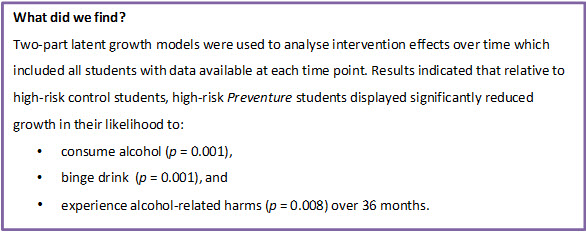
This study demonstrated the long-term effectiveness of Preventure, a selective personality-targeted preventive intervention, in reducing the uptake of alcohol use, alcohol misuse and alcohol related harms among adolescents over three years. Analyses showed that compared to the control group, high-risk students who received the Preventure intervention displayed reduced uptake of alcohol consumption and binge drinking, as well as reduced alcohol-related harms. This trial is the first to demonstrate long-term effects of a selective alcohol prevention program over a three year period, and the first to demonstrate the effectiveness of Preventure outside the United Kingdom or Canada. In addition, it is the first trial of an effective selective prevention program in Australia [36], indicating that the Preventure program is feasible in an Australian context.
Acknowledgments
This study was funded by the National Health and Medical Research Council (APP1004744).The authors would like to acknowledge the participating schools, students, teachers and health professionals. The research team also acknowledges the assistance of the NSW Department of Education and Communities for access to its schools (SERAP 2011201). PC is the developer of the Preventure program.
Research Staff
Dr Nicola Newton, Professor Patricia Conrod (Université de Montréal), Associate Professor Tim Slade (CREMS, NDARC), Dr Natacha Carragher, Dr Katrina Champion (CREMS, NDARC), Dr Emma Barrett (CREMS, NDARC and MUSC), Ms Erin Kelly (CREMS, NDARC), Ms Natasha Nair, Dr Lexine Stapinski (CREMS, NDARC) and Professor Maree Teesson (CREMS, NDARC).