The National Drug Research Institute is designated as a World Health Organization (WHO) Collaborating Centre for the Prevention of Substance Use and Substance Use Disorders. This Research Focus outlines two research projects being undertaken as part of NDRI’s WHO designation.
NDRI WHO projects focus on preventing opioid overdose, minimising alcohol harms among adolescents
December 2024
Teaser image
Project 1: opioid overdose in low and middle-income countries – building on the stop overdose safely initiative
Opioid overdose has long been known to cause an unacceptable number of preventable deaths worldwide.(1) In response, almost 10 years ago member states of the United Nations resolved to improve responses to opioid overdose globally.(1) This resolution also included expanding the use of naloxone, the key opioid overdose antidote, as recommended by World Health Organization (WHO) Guidelines.(2) In response, the WHO and the United Nations Office on Drugs and Crime launched the Stop Overdose Safely (S-O-S) initiative in 2016, one component of which was a demonstration project of overdose management and response training in three Central Asian countries (Kazakhstan, Kyrgyzstan and Tajikistan) and Ukraine.(2, 3)
The S-O-S demonstration project
Fig1 naloxone kit used in Kyrgyzstan during SOS implementation
The S-O-S demonstration project involved training more than 14,000 potential opioid overdose witnesses in overdose response and naloxone administration and the distribution of more than 16,000 take home naloxone kits (see figure 1).(4) These kits were designed to be easily carried and comprised two 400 microgram ampules of naloxone along with clean equipment for intramuscular injection. Findings from the evaluation of the demonstration project showed that participants trained using the S-O-S materials used naloxone at around 90% (depending on country) of witnessed opioid overdoses, in line with anticipated targets.(3) Moreover, participation in the program had other important impacts such as making people feel more valued and empowering them to take control of their lives.(5)
S-O-S training for opioid overdose response
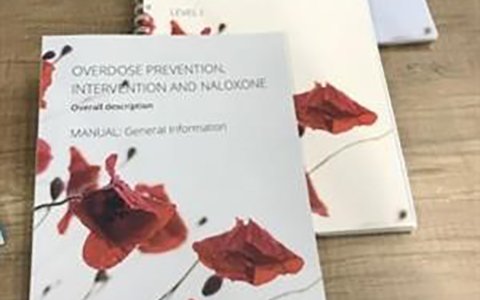
The S-O-S training materials were designed to be implemented across a training cascade whereby master trainers would train ‘level II’ trainers in terms of conducting training of ‘level III’ trainers who would have ultimate responsibility for training potential opioid overdose witnesses in opioid overdose recognition and effective response (including naloxone administration).(4) Although level II trainers are expected to know how to recognise and respond to opioid overdoses, and train level II trainers in how to train others to do so, their training was more focused on the logistics of rapid up-skilling of the level III trainers. Accompanying all of these stages of the S-O-S training cascade were manuals designed to fit each application (see Figure 2).
Evaluation of these material as tested in real world conditions through the S-O-S project showed that the S-O-S training was effective in improving attitudes towards opioid overdose response as well as reported knowledge about opioid overdose and effective responses.(4) Improvement was evident across all training evaluation measures, but the largest impact was noted for those participants who did not report a history of injecting drug use.(4)
Future S-O-S work
As part of its ongoing work as a WHO Collaborating Centre, NDRI has been helping prepare the S-O-S materials and project findings for publication and widespread dissemination. This work has included updating materials to reflect recent patterns and trends in the use of opioids as well as ongoing feedback from the sector. It is expected that the final updated S-O-S training materials will be published in early 2025.
Project 2: co-designing school-based alcohol education programs in low and middle income countries
As part of NDRI’s commitment in its role as a World Health Organization Collaborating Centre, Associate Professor Nyanda McBride and her team are in the initial stages of a project to scope, map, and assess potential for developing or adapting school-based alcohol education programs in low and middle income countries. The project has an Advisory Group with members who have previously been responsible for cultural adaption of school-based alcohol education programs, and will work directly with key academic, education and health representatives, and young people in each country. The project will be conducted over several stages, with some stages conditional on external funding.
The School Health and Alcohol Harm Reduction Empirical Model of Intervention Development (SHAHRP Model) will be used during formative program development as it has replicated behavioural efficacy. This behavioural efficacy has been demonstrated in the original Australian SHAHRP Randomised Controlled Trial (RCT) [6] and in international and national replications of the SHAHRP RCT [7-9] (see sharhp.info). The SHAHRP Model has also been used in program and research development and RCTs by other researchers who have achieved behavioural impact in school-based intervention research, e.g. the OurFuture’s (nee Climate Schools) school-based research program [10]. Most recently, the University of Pittsburgh have used the SHAHRP Model, the SHAHRP intervention materials and the parametrically assessed SHAHRP research tools in their intervention research with LGBTQ youth in the USA.
The NDRI SHAHRP work has a longstanding record of translational impact to policy and practice, which bodes well for potential policy and practice impacts in countries participating in the NDRI/WHO Project. SHAHRP has been cited in 77 policies (25 Australia, 52 international), and over 2500+ organisations from 54 countries and a diverse range of sectors have adopted and adapted the SHAHRP program into their practice and/or service provision.
The SHAHRP model
The SHAHRP model is a staged process leading to the co-design of school-based and other interventions, and has empirical evidence for increasing the potential for behaviour change [6-11].
- Relevant finding from past literature. Identifying components, strategies, content and mode of delivery from programs selected for inclusion in systematic literature reviews which have demonstrated some potential for behavioural effectiveness. If past literature provides limited findings, review of similar literature may help uncover possible aspects that can guide program methods.
- Incorporate relevant theory. Theories relevant to the focus of the program can help to conceptually identify the range of factors that impact the behaviour of interest. Identification of these factors can be used to help build a comprehensive list of factors that may help to modify behaviour and be included in evaluation measures.
- Incorporate expert advice. The range of experts who can provide guidance to program development include content, intervention and setting experts such as academic researchers, policy/practice professionals, and others who work directly with the consumer group or the setting. Expert involvement should occur from the inception of program development to optimise potential for behavioural impact and to optimise the adequate measurement of behavioural impact. The aim is to develop rigorously developed programs that will be accepted in to systematic reviews, provide guidance to future programs, and will be a basis for organisational adoption.
- Consumer group involvement in development and pre-assessment of programs. Consumer involvement in program development is critical for behaviour change as it ensures that strategies, content and mode of delivery are meaningful and relevant to those participating in the program. If consumer involvement is not included then the possible behavioural effectiveness of the program is reduced [12]. Several steps are required to ensure that consumer experiences guide program development. These include asking consumers about their experiences, knowledge, values and beliefs; asking consumers about their recommendations for program components, strategies, content and mode of delivery; systematically incorporating consumer identified detail in a pilot of the program; and, piloting the program with the consumer groups to refine the program. The consumer groups include potential participants in the program and setting implementers (service providers) and may also include other decision makers and stakeholders depending on the scope of the program.
- To ensure the inclusion of all relevant findings from the systematic program development process, methodically table all key findings and plan placement of findings into projects, content, activities, recommendations and guidelines. Maintain a table noting where placement has occurred by SHAHRP Model element (systematic review, theory, target groups input, expert input) so that regulation is more readily achieved, and is documented in detail for future reporting, for replication purposes and to enable a clearer understanding of inclusions that contribute to behaviour change. This process is particularly important when analysis is linked to fidelity of implementation data.
- A systematic approach to program development needs to be teamed with appropriate evaluation methodology. Evaluation design should be established prior to the conduct of the program as pre-assessment of, for example, knowledge, attitudes, previous experiences, behaviours and behavioural intentions, which is required to statistically analyse against post program measures to identify change. Evaluation design and methodology is complex and requires expert input to reduce bias and increase the reliability of evaluation findings. Quality evaluation design and methods will result in acceptance into systematic literature reviews and help build the knowledge base of the research and professional fields.
Application of the SHAHRP model to the NDRI/WHO activity
For the purposes of the NDRI/WHO Project, the SHARHP Model processes have been listed as phases of activity. Phases 1 and 2 are currently active.
Phase 1
Phase 1 includes a narrative review of peer-reviewed systematic literature reviews and program published in scientific journals, and in the grey literature from low and middle income countries, on school-based alcohol education, with an orientation to behavioural impact. The NDRI team will identify and summarise programs and program components that contribute to behavioural impact, and will summarise the development orientation (high/middle/low income), theoretical basis, risk of bias, and strength of evidence. Lead authors of accepted programs may be contacted to identify any other additional papers, progression or issues about specific programs that contribute to understanding about behaviour change methods in the context of low to middle income countries.
As part of our co-design emphasis, Key Contacts in each country will be asked if their country has conducted, evaluated or reviewed school-based alcohol education, and if so, to provide the review/s to the NDRI team for inclusion in our review.
Phase 2
Phase 2 includes several consecutive steps including: mapping prevalence of alcohol use in school-aged children in each country; mapping current school-based alcohol education practice via interviews with key education sector staff; identifying the scope to provide alcohol programs in the school setting with school-based staff; and conducting focus groups with young people to identify the lived experience of alcohol use and alcohol use situations for young people in each country.
This comprehensive co-designed process will enable the development of country specific programs which are uniquely tailored to the school setting and the alcohol-related experiences of young people in each country.
Engagement with education sector personnel (Key Informant interviews) involves those in a central education role (national, state and/or jurisdiction based) who are responsible for overseeing decisions on school-based alcohol education curriculum and/or health education curriculum in each participating country. Liaising with education sector staff who oversee the school-based alcohol education curriculum area assists in providing a detailed map of school-based alcohol education in the country, including organisational structure, decision-making processes, research engagement processes and dissemination processes. This information is a prerequisite to defining engagement during future phases of our activity.
Engagement with school-based staff (In-depth interviews) who are responsible for introducing and implementing alcohol education in the school setting helps to assess the potential acceptance and adoption of programs, as well as how to tailor programs to best suit the school setting in each country. To conduct and create behaviourally effective school-based alcohol programs, it is important to understand how the program will fit into and complement the existing curriculum, any training needs for teachers who will teach alcohol education, the potential for alcohol education in or across various year groups, the type and methods of delivery that best suit the student group, specific content to increase safety in students exposed to alcohol-use situations as well as identifying other enablers and barriers to school-based alcohol education. In-depth interviews will be conducted with teachers who teach students in the transition age between mostly not drinking to mostly starting to experiment with alcohol use. Therefore, local prevalence data is critical to identifying the relevant age/year group.
Engagement with young people (focus groups) will occur with students who have previously had experience in alcohol use situations. This experience helps to identify more detailed information which can be incorporated into program development. These experiences may be associated with young people’s own consumption of alcohol, and may also be associated with other people’s drinking. Focus groups will allow young people to identify and discuss strategies, which are supported and reinforced by their peer group, and which can reduce risky consumption and increase safety in alcohol use situations. Obtaining this type of information directly from young people, in a group where they can freely discuss alcohol-related issues without any consequence has been critical in developing programs which have subsequently been assessed in RCTs as having behavioural impact.
Phase 2 of the NDRI/WHO project uses qualitative methods for sector staff key informant semi-structured in-depth interviews, school staff semi-structured in-depth interviews and focus groups with young people. Gaining detailed qualitative data is critical to create programs which match the needs, structures and processes in each country. The project meets qualitative methods requirements related to the design, development and selection of study participants, and will intentionally focus on saturation of data, maintaining the participant’s authentic voice and maintaining a chain of evidence to reduce selection, analysis and reporting bias [13-15].
Country engagement to date
Invitation to the project has occurred via existing WHO and NDRI contacts. To date, 13 self-selected countries from across five continents are participating in the project. Additional countries in South America are being alerted to the project.
Future phases (subject to funding)
Phase 3
Determine the need and depth of possible program development for self-selected country or for pilot countries.
Phase 4
Initiate development of culturally appropriate program development or program modification to optimise potential for school-based alcohol education behavioural impact.
Phase 5
Disseminate programs or assess by Randomised Controlled Trial to identify potential behavioural impact.
- UNODC. Special Session of the United Nations General Assembly on the World Drug Problem. https://wwwunodcorg/ungass2016/. 2016.
- UNODC/WHO. Joint UNODC/WHO initiative addresses public health impact of community management of opioid overdose. [Available from: https://wwwunodcorg/unodc/en/frontpage/2017/March/joint-unodc-who-initiative-addresses-public-health-impact-of-community-management-of-opioid-overdosehtml. 2017
- Dietze P, Gerra G, Poznyak V, Campello G, Kashino W, Dzhonbekov D, et al. An observational prospective cohort study of naloxone use at witnessed overdoses, Kazakhstan, Kyrgyzstan, Tajikistan, Ukraine. Bull World Health Organ. 2022;100(3):187-95.
- UNODC-WHO. Stop-Overdose-Safely (S-O-S) project implementation in Kazakhstan, Kyrgyzstan, Tajikistan and Ukraine: summary report. Geneva: World Health Organization and United Nations Office on Drugs and Crime; 2021.
- Walker S, Dietze P, Poznyak V, Campello G, Kashino W, Dzhonbekov D, et al. More than saving lives: Qualitative findings of the UNODC/WHO Stop Overdose Safely (S-O-S) project. Int J Drug Policy. 2022;100:103482.
- McBride N, Farringdon F, Midford R, Meuleners L, Phillips M. Harm minimisation in schools. Final results of the School Health and Alcohol Harm Reduction Project (SHAHRP). [Erratum 99 528]. Addiction. 2004;99:278 - 91.
- McKay M, McBride N, Sumnall H, Cole J. Reducing the harm from adolescent alcohol consumption: Results from an adapted version of SHAHRP in Northern Ireland. Journal of Substance Use. 2012;17(2):Early online 1-24.
- McKay M, Agus A, Cole J, Doherty P, Foxcroft D, Harvey S, et al. Steps Towards Alcohol Misuse Use Prevention Programme (STAMPP): a school-based and community-based cluster randomised controlled trial. BMJ Open. 2018;8e019722.
- Midford R, Cahill H, Lester L, Ramsden R, Foxcrogt D, Venning L. Alcohol prevention for school students: Results from a 1-year follow up of a cluster-randomised controlled trial of harm minimisation school drug education. Drugs Education, Prevention, and Policy. 2018;25(1):88-96.
- Vogl L, Teesson M, Andrews G, Bird K, Steadman B, Dillon P. A computerized harm minimization prevention program for alcohol misuse and related harms: randomized controlled trial. Addiction. 2009;104:564-75.
- McBride N. School Health and Alcohol Harm Reduction Project Empirical Model for Developing Interventions to Increase the Potential for Behaviour Change. National Drug Research Institute, Curtin University: Perth. 2020.
- McBride N, Farringdon F, Meuleners L, Midford R. School Health and Alcohol Harm Reduction Project. Intervention development and research procedures: Monograph 59. National Drug Research Institute: Perth. 2006.
- McBride N. Intervention Research: A practical guide for developing evidence-based school prevention programs. Singapore: Springer; 2016.
- Kvale S, Brinkmann S. Interviews: Learning the craft of qualitative research interviewing: Sage; 2009.
- Pope C, Ziebland S, Mays N. Analysing qualitative data in qualitative research in health care. The British Medical Journal. 2000;320(7227):114-6.